

A real-time strategy workbench for Formula 1
- Year
- 2026
- Role
- Product · Architecture · Backend · Frontend
- Stack
- Python · FastAPI · React · TypeScript · WebSocket · scikit-learn · PyTorch
- 498passing tests
- livetelemetry stream
- Monte Carlochampionship simulation
Figures counted at source, August 2026.
The problem
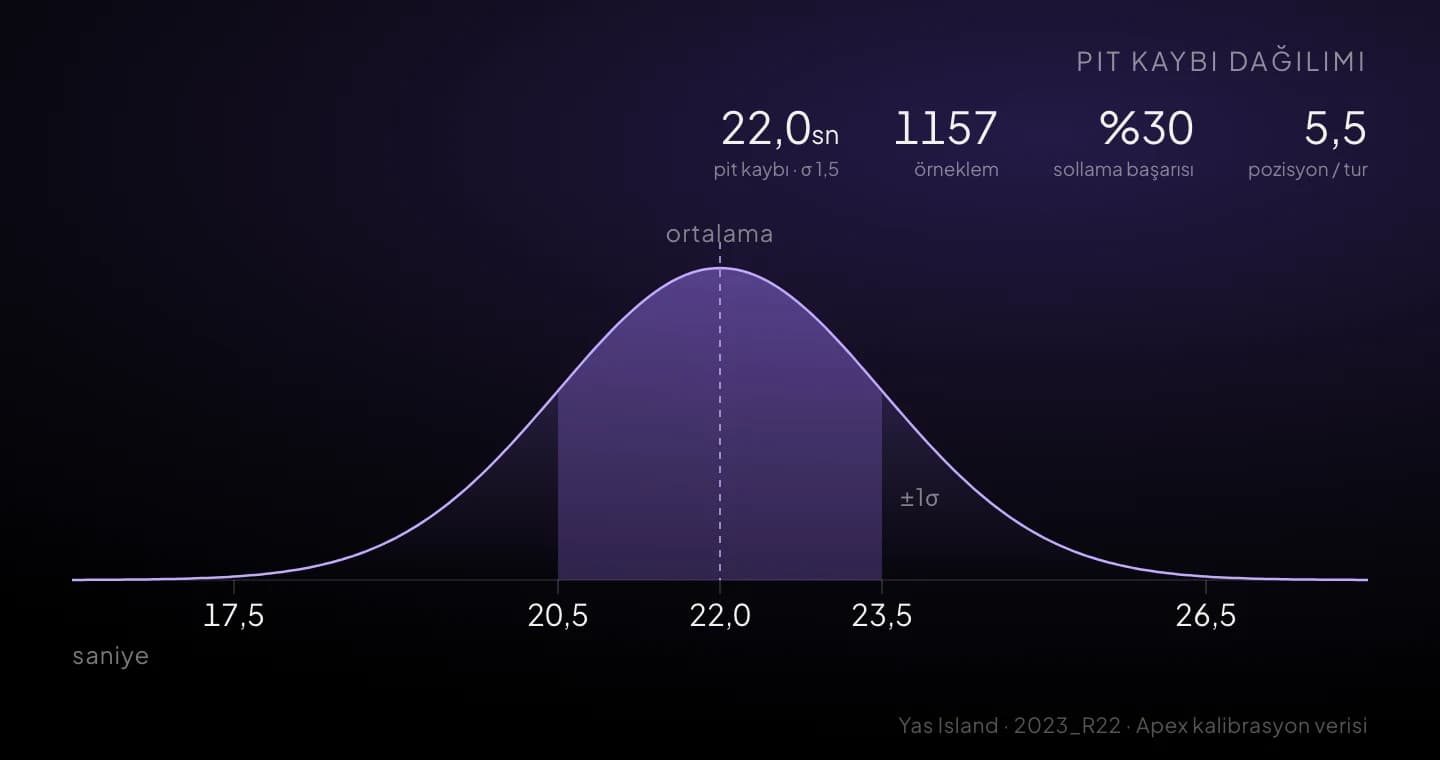
Formula 1 strategy calls are made in seconds and decide races. From the outside, the reasoning is invisible: tyre degradation, fuel correction, undercut windows, safety-car probability, all of it has to be weighed at once. Existing tools either show raw data or hand you a number without the reasoning behind it.
Approach
Apex is built as a workbench, not a prediction box. Physics-based models, machine learning and Monte Carlo simulation meet in one interface, and every recommendation can explain itself.
- Live session tracking via OpenF1, streamed over WebSocket
- Tyre degradation: online RLS estimators plus a neural model, with cliff-risk prediction
- Counterfactual analysis: in-race and pre-race "what if we had" scenarios
- Event-sourced lap processing: stint detection, anomaly filtering, fuel correction
- Explainability engine: every recommendation ships with a sensitivity analysis
- Natural-language race summaries in Turkish and English
Outcome
498 tests pass and the pipeline runs against live race data. What Apex demonstrates is this: deep domain complexity can be turned into a working, tested system that explains its own reasoning.
Building something?
Say what you want built; a written proposal follows within two business days.