



Two agent studios for Claude Code
- Year
- 2026
- Role
- Design and architecture · Agent authoring · Process and gate design
- Stack
- Anthropic · Node.js
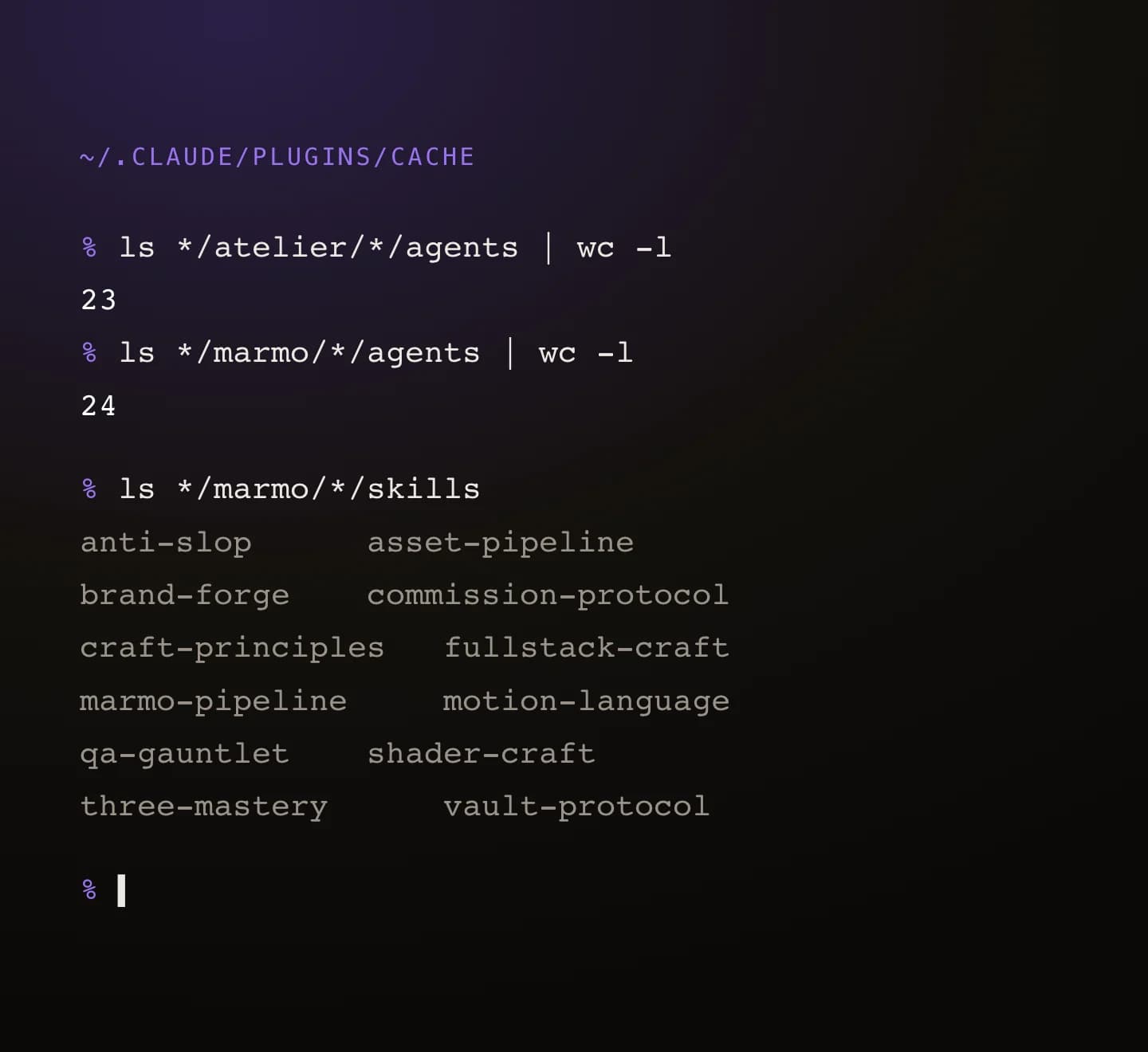
- 23+24specialist agents, two plugins
- 7phases · six gates
- 2gates with a binding veto
Figures counted at source, August 2026.
The problem
Ask a model to "build me a website" and the result lands in almost exactly the same place every time: the same rounded cards, the same two typefaces, the same violet gradient. That is not a capability problem. It happens because no decision was ever made explicitly. When a choice is not forced, the model goes to the average, and the average is what generic means.
The second problem is quieter: when one agent both produces the work and judges it, it approves itself. A quality gate held by the party doing the work is not a gate.
Approach
Both are built on the same two ideas. First: every phase forces itself into a decision. One direction card, one type pairing, one palette with assigned roles, one signature moment. Listing options is forbidden; choosing is mandatory. Second: whoever judges is a different agent from whoever produced, and can actually stop the work. The anti-slop auditor holds binding veto power at two gates, and only the user can waive it. Not even the creative director who wrote the direction card can.
- Atelier: 23 agents, 7 commands, 5 knowledge packs. Seven phases and six gates from brief to ship, with the Figma and Playwright MCP servers bundled in
- Marmo: 24 agents, 10 commands, 12 knowledge packs. 3D-first, with phases named BLOCK, QUARRY, SKETCH, MODEL, CARVE, POLISH, UNVEIL
- Gate state is written to disk, so a run can be interrupted and resumed without redoing finished work
- Each agent file carries its profession's working discipline, scope boundary and output contract; limits like "report-only" and "frontend-only" live in prose rather than types, but they bind
- In Marmo, asset production splits into five lanes: find it, code it, build it in Blender, generate it, or commission it
- Project memory is an Obsidian vault, so intermediate output accumulates in files rather than in a chat history
Outcome
Both are in use — Atelier 0.2.3, Marmo 0.1.0 — and both are still gaining agents. Marmo is also packaged as a commercial product. The gain is not in the count: whether an army of agents works has less to do with how many there are than with how authority is divided between them. Who decides what, who can stop whom, which decisions go back to the user. When those three answers are not written down, what you get is not a studio; it is twenty agents talking at once.
Building something?
Say what you want built; a written proposal follows within two business days.